
Artificial Turf vs. St. Augustine Grass in Florida: The Real Cost Comparison
St. Augustine grass looks beautiful on the day it's installed. Lush, thick, dark green — exactly what a Florida backyard should look like. Then Jacksonville summer hits. Then the chinch bugs arrive. Then the brown patch fungus shows up after three straight weeks of afternoon thunderstorms. Then your irrigation bill arrives for August.
That's the real life of a St. Augustine lawn in Northeast Florida. And if you've been maintaining one for more than a few years, you already know the drill.
This post isn't a sales pitch — it's a straight-up cost breakdown. We're going to run the actual numbers on what St. Augustine grass costs to install, maintain, repair, and replace in Jacksonville over a 10-year period, and compare it to what a quality artificial turf installation costs over the same window. By the end, you'll have the information you need to make the decision that's right for your yard and your budget.
The Upfront Cost: St. Augustine Sod vs. Artificial Turf
What St. Augustine Sod Costs to Install
St. Augustine sod materials run $0.45–$0.90 per square foot depending on the variety and time of year. Professional installation — which includes removal of existing vegetation, soil prep, delivery, and labor — brings the total to roughly $1–$2 per square foot installed. For a typical Jacksonville backyard of 1,000–1,500 square feet, you're looking at $1,000–$3,000 to get sod in the ground.
That's the number that makes St. Augustine look like the obvious budget choice. But it's only the beginning of the cost story — and frankly, the cheapest part of it.
What Artificial Turf Costs to Install in Jacksonville
Quality residential artificial turf in Jacksonville runs $10–$15 per square foot installed, which includes base preparation, crushed aggregate, the turf product itself, infill, and edge work. For that same 1,000–1,500 square foot backyard, the installed cost is typically $10,000–$22,500. You can get a precise number for your yard on our artificial grass installation cost page — we publish our pricing ranges because we believe you should know what you're getting into before you call anyone.
That upfront gap is real. We're not going to pretend it isn't. But the next sections are where the math starts to shift.
Why the Gap Is Smaller Than It Looks
Two things close the upfront gap faster than most homeowners expect. First, artificial turf lasts 15–20 years with minimal upkeep. St. Augustine in Northeast Florida's climate — clay soil, chinch bugs, irrigation restrictions, and humidity — typically requires partial or full resodding every 5–10 years, sometimes sooner. So the "cheap" install often gets paid twice or three times over a 15-year window.
Second, we offer 0% financing, so the upfront cost doesn't have to land all at once. The ongoing savings, however, start immediately.
The Annual Maintenance Cost Nobody Talks About
Mowing, Edging, and Lawn Service in Northeast Florida
Jacksonville's growing season is long — roughly April through October — and St. Augustine grows aggressively in the summer heat. During peak season, it needs weekly mowing to stay healthy and prevent the overgrowth surcharges most lawn services charge. Weekly professional service for a typical residential yard in the Jacksonville area runs $35–$52 per visit.
Annual mowing costs alone — factoring in peak-season weekly service and reduced winter frequency — run $1,500–$2,500 per year for most homeowners using a professional service. DIY mowers can reduce this, but you're still paying in time, equipment, fuel, and blade sharpening. And you're still spending your Saturday morning in 90°F heat instead of in your backyard enjoying it.
Fertilizer, Herbicide, and Weed Control
St. Augustine requires fertilization 3–4 times per year to maintain its density and color in Florida's climate. Budget $150–$400 per year for fertilizer applications, depending on yard size and whether you're DIY or professional. Add weed control treatments — atrazine, pre-emergents, spot treatments — and you're typically adding another $100–$250 annually.
That's $250–$650 per year in chemistry before you've touched a pest or disease issue.
What Does Irrigation Actually Cost Under SJRWMD Restrictions?
St. Augustine grass needs about 1–1.5 inches of water per week. One inch of water covers roughly 600 gallons per 1,000 square feet. Under St. Johns River Water Management District (SJRWMD) irrigation restrictions, Northeast Florida homeowners are limited to automatic sprinkler use twice per week. During dry stretches in June through September, that's often not enough, and hand-watering is the only legal supplement.
For a 1,500 square foot lawn, irrigation costs typically run $400–$800 per year in additional water bills. Larger yards — a half-acre or more — can push that number significantly higher. And during drought years, which hit Northeast Florida regularly, under-watered St. Augustine becomes stressed St. Augustine, and stressed St. Augustine becomes chinch bug dinner.
The Hidden Cost: Chinch Bugs, Fungus, and Resodding
Why St. Augustine Grass and Jacksonville Are a Complicated Match
Here's the thing about St. Augustine in Northeast Florida: it's the most popular grass choice in the region and the most vulnerable to the region's specific threats. Chinch bugs — the southern variety that thrives in hot, dry conditions — are Jacksonville's #1 lawn pest, and Turner Pest Control, one of Northeast Florida's most established pest companies, specifically calls out St. Augustine as their preferred target. Unlike northern states where chinch bugs go dormant in winter, in our climate they're active
year-round. A stressed lawn — which any lawn under SJRWMD watering restrictions during a dry stretch becomes — is an open invitation.
Meanwhile, Jacksonville's heat and humidity create the perfect conditions for brown patch fungus, gray leaf spot, and take-all root rot — all of which disproportionately affect St. Augustine. The symptoms look almost identical to drought stress and chinch bug damage, which means homeowners often mis-diagnose and mis-treat before the right solution gets applied.
What Pest and Disease Treatment Actually Costs
A professional lawn pest control program in Northeast Florida — covering chinch bugs, sod webworms, and preventative fungicide treatments — runs roughly $400–$800 per year for a mid-size residential lawn. One-off reactive treatments for an active chinch bug infestation or a brown patch outbreak run $150–$400 per visit, and infestations that spread before being caught can require multiple applications.
Artificial turf has no pest vulnerabilities. No chinch bugs. No fungus. No sod webworms. There is nothing for them to eat, no thatch for them to hide in, and no soil to breed in. That's not a marketing claim — it's just biology.
What Happens When St. Augustine Needs to Be Replaced?
Chinch bug damage that spreads before it's caught — which happens fast, sometimes within days — can kill large sections of a lawn that won't recover. Same with severe brown patch or take-all root rot. When that happens, resodding is the only fix.
Partial resodding typically costs $500–$2,000+ depending on affected area and site preparation needs. Full resodding brings you back to the original installation cost — or higher, since material and labor prices tend to increase over time. Many Jacksonville homeowners resod at least once every 5–8 years due to pest damage, drought stress, or wear in high-traffic areas.
What Does Artificial Turf Really Cost Per Year to Maintain?
The Honest Maintenance Reality
Once installed, artificial turf maintenance is genuinely minimal. A rinse with the hose every week or two, a brush-through of high-traffic areas a few times a year to keep the fibers upright, and clearing debris before it breaks down on the surface. Most homeowners spend $100–$200 per year on maintenance — mostly their time, occasionally a professional refresh.
That's it. No mowing. No fertilizing. No pest treatments. No fungicide applications. No irrigation system repairs. No resodding. The $100–$200 number holds relatively steady whether it's year two or year eighteen.
What You Stop Paying Immediately
The day your artificial turf goes in, you stop paying for:
Weekly lawn service ($1,500–$2,500/year)
Fertilizer and weed control ($250–$650/year)
Pest control and fungicide treatments ($400–$800/year)
Irrigation costs above your baseline water usage ($400–$800/year)
Lawn equipment, fuel, and maintenance ($200–$400/year)
That's $2,750–$5,150 per year in ongoing costs that disappear on day one.
Water Savings — The Number Most People Underestimate
Water savings alone are significant. Synthetic grass reduces lawn water usage by approximately 70% compared to natural grass. For a Jacksonville homeowner with a 1,500 square foot lawn, that translates to $400–$800 per year in water bill reductions — money that compounds over every year of the turf's lifespan.
One of our Jacksonville customers, Robyn B., noticed the difference right away after we installed her pet- and kid-friendly backyard: "The turf has completely transformed our outdoor space — it's clean, low maintenance and has cut down on our irrigation bill." Her kids and dogs use it every day. That's the lifestyle shift that numbers alone don't fully capture.
The 10-Year Cost Breakdown: Side by Side
Let's run the numbers on a 1,500 square foot Jacksonville backyard. These are honest, conservative estimates based on real regional data.
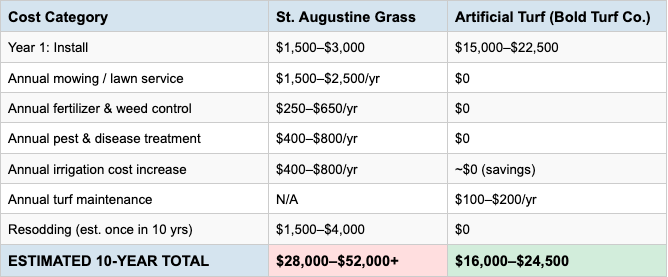
The break-even point on a typical Jacksonville installation lands between years 5 and 7. After that, every year of artificial turf's 15–20 year lifespan is money you're not spending on St. Augustine.
And that's the conservative version of the numbers. It doesn't account for a major chinch bug outbreak requiring emergency resodding, a drought year that spikes water bills, or the time value of 100+ hours per year you're spending on lawn maintenance instead of actually using your backyard.
So When Does Artificial Turf Make Sense in Jacksonville?
It's the Right Call If…
Artificial turf tends to make the most sense for Jacksonville homeowners who:
Have dogs or kids who use the backyard regularly — no mud, no dead patches, no tracking anything inside
Are tired of fighting the maintenance cycle — the mowing, fertilizing, pest treatments, and irrigation juggling act
Have problem areas that St. Augustine struggles in — shaded spots, high-traffic zones, yards with clay drainage issues
Want a yard that looks good year-round without spending money to make it look that way
Are planning to stay in their home for 7+ years — that's where the 10-year math really works in your favor
St. Augustine Still Makes Sense If…
We'll be honest here too. St. Augustine grass can still be the right choice for some homeowners:
You have a very large yard where the artificial turf install cost would be substantial
You genuinely enjoy lawn care and find it relaxing — some people do
You're in a short-term housing situation where the long-term ROI math doesn't apply
Your yard has minimal pest pressure and good irrigation coverage already in place
What About Pet Owners?
About 80% of our customers have dogs — and for most of them, the decision is easy once they understand how pet-friendly artificial turf works. No more yellow patches from dog urine. No more muddy paws. No more grass clippings tracked through the house. And PFAS-free materials mean the backyard your dogs use every day isn't exposing them to chemicals you'd rather avoid.
St. Augustine under heavy dog traffic deteriorates quickly — the grass can't handle the wear, urine damages root systems, and digging creates bare spots that become mud pits. Artificial turf built for pets handles all of it without flinching.
The Bottom Line
St. Augustine grass costs less to install. Artificial turf costs less to own. That's the honest summary of the comparison for Jacksonville homeowners who run the numbers all the way through — not just to the end of year one, but to the end of year ten.
The pest pressure, water restrictions, clay soil drainage issues, and maintenance demands that Northeast Florida's climate places on natural grass are real. They compound over time. And they show up every year in your budget whether you're ready for them or not.
If you're ready to run the numbers on your specific yard, we're happy to give you a straight answer. Bold Turf Co. is a Jacksonville-based, family-owned team with 100+ local installations and transparent pricing — no hidden fees, no bait-and-switch estimates.
Call us at (904) 575-5803 or visit boldturfco.com to schedule your free estimate. We'll tell you exactly what it costs, what you'll save, and whether it makes sense for your yard.
